By Marley Grant, NY Elite Cannabis··14 min read·Updated November 2026
CBN (cannabinol) is a cannabinoid that forms when THC breaks down over time from exposure to air, light and heat. It binds to the same CB1 receptor as THC, but much more weakly, so it is considered mildly intoxicating at most. CBN is best known today as an ingredient in gummies and drops marketed for nighttime use, although the research behind those claims is limited and mixed.
This guide explains what CBN is, how it is made, what it feels like, how it compares to CBD, THC and CBG, what studies have actually found, and what to know about drug tests and New York law. It comes from NY Elite Cannabis, a licensed dispensary in Bayside, Queens. It is not medical advice, and we do not claim CBN treats or helps any condition.
CBN is short for cannabinol, one of more than 100 cannabinoids found in cannabis. Unlike THC and CBD, the plant does not make much CBN directly. Most of it appears after harvest, when THC reacts with oxygen and is exposed to light and heat. That is why old flower, or cannabis left in a warm, bright place, tends to have more CBN and less THC (Corroon, 2021; 2022 review in Plants).
CBN also has a place in history: it was the first cannabinoid ever isolated. Chemists pulled it from hashish in the 1890s, decades before THC was identified, and its structure was worked out in the 1930s and confirmed in 1940 (2022 review in Plants).
How is CBN made?
Naturally, by aging: THC oxidizes into CBN over time. Heat, light and air speed this up. Fresh cannabis usually has only small amounts.
In a lab, from other cannabinoids: most CBN in products is produced by converting THC or CBD into CBN with a chemical reaction, because extracting it from aged plants is not practical at scale (2022 review in Plants).
How CBN is made matters for the law in New York, which treats lab-converted cannabinoids differently in the hemp market. More on that below.
Does CBN get you high?
Not much, if at all, on its own. CBN is a partial agonist at the CB1 receptor, the same receptor THC uses to produce a high, but it binds roughly 10 times more weakly than THC in lab measurements (Corroon, 2021). Older human studies were mixed: one study that gave CBN intravenously reported a mild, marijuana-like high, but only at doses far larger than a typical THC dose, and most studies of CBN taken by mouth found no THC-like effects.
Popular articles often say CBN is "about 10%" or "about 25%" as strong as THC. Neither number is well established in people, so treat them as rough guesses.
The bigger factor in practice: most CBN products at dispensaries also contain THC, often in ratios like 2:1 THC to CBN. Those products will get you high because of the THC, so read the THC milligrams on the label.
What does CBN feel like?
People describe CBN alone as subtle. Many CBN products are marketed with nighttime names and imagery, and some people say they feel relaxed or drowsy when they use them. Because so many of those products also contain THC, it is hard to separate what the CBN is doing from what the THC is doing. If you want to know how CBN alone affects you, look for a product where it is the main cannabinoid and check the lab results.
Cannabinoid receptors: CBN binds CB1, the receptor behind THC's high, but about 10 times more weakly than THC. It also binds CB2, a receptor found mostly in immune tissue.
Breakdown: like THC and CBD, CBN is processed by liver enzymes, which is why it can interact with medications that use the same enzymes (NCCIH).
What those lab effects mean for people has not been worked out. Researchers have studied CBN in a range of cell and animal experiments, but those results have not been confirmed in human trials, so we do not treat them as benefits.
Does CBN actually make you sleepy? What the research says
This is the question most people searching for CBN are asking, so here is what studies have found, described as plainly as we can. CBN is not approved by the FDA for any use, and we do not claim it treats sleep problems.
About 290 adults who rated their sleep as poor, for 7 nights
Placebo, 20 mg CBN, or 20 mg CBN with 10, 20 or 100 mg CBD
Overall sleep quality with 20 mg CBN was not significantly different from placebo. The CBN group reported fewer awakenings and less overall sleep disturbance. No difference in time to fall asleep or next-day fatigue. Adding CBD did not change results.
20 adults with diagnosed insomnia, measured overnight in a sleep lab
One dose of 30 mg CBN, 300 mg CBN, or placebo, on separate nights
No significant change in the main measure (time awake after falling asleep). At 300 mg, some secondary measures changed, including self-rated sleep quality. The authors called for larger, longer trials.
So the honest summary is: CBN is widely marketed for nighttime use, but the research is small and the results are mixed. The doses used in the newer trials (20 mg to 300 mg) are also much higher than the amount in many products. If sleep is a concern for you, talk to a doctor.
CBN vs CBD: what is the difference?
CBN and CBD are often sold side by side and even combined in the same gummy, but they are quite different:
CBN vs CBD vs THC vs CBG
CBN
CBD
THC
CBG
Gets you high
Mildly at most
No
Yes
No
How it forms
THC breaks down with age, heat and light
Plant converts CBGA → CBDA → CBD
Plant converts CBGA → THCA → THC
From CBGA, the precursor acid
Acts on CB1 receptor
Weak partial agonist
Low affinity, does not activate it like THC
Partial agonist, the source of the high
Weak
Drug test risk
Can cross-react with some THC screens
Only if the product contains THC
Yes
Only if the product contains THC
Human research
Very limited
More studied; one FDA-approved drug
Most studied
Very limited
Is CBN "stronger" than CBD? They do different things. CBN has some activity at the receptor THC uses and CBD does not, which is why CBN can be mildly intoxicating and CBD is not. For the bigger comparison, see our CBD vs THC guide, and for the precursor cannabinoid, our guide to what CBG is.
CBN vs THC
CBN is literally made from THC: as THC ages, it turns into CBN. Along the way the molecule loses most of its ability to activate CB1, so CBN is far weaker. That is also why very old flower can feel less potent. The THC has partly turned into CBN. If you want flower to keep its THC, store it in an airtight container somewhere cool and dark.
CBN vs CBG
CBN and CBG are both "minor" cannabinoids that show up in blended gummies and tinctures, but they come from opposite ends of the plant's life. CBG comes first: its acid form, CBGA, is the starting material the plant turns into THC and CBD. CBN comes last: it forms when THC breaks down after harvest. CBG is not intoxicating, while CBN can be mildly intoxicating because it still binds CB1 a little. Both have very little human research. Read more in our guide to what CBG is.
What is CBN in gummies? CBN and THC together
Most CBN gummies in New York dispensaries combine CBN with THC, and some add CBD or CBG. The label shows a ratio, such as 2:1 THC:CBN (twice as much THC as CBN) or 1:5 THC:CBN (five times as much CBN as THC). The intoxicating effect mostly comes from the THC, so the THC milligrams per piece are the number to watch. New York caps adult-use edibles at 10 mg of THC per serving and 100 mg per package.
Brands combine the two because CBN is marketed for nighttime use, but there is no solid research showing that adding CBN to THC changes how a gummy feels. Treat a THC:CBN gummy like any THC edible: start with one piece or less, wait at least 2 hours before taking more, and do not drive.
Will CBN show up on a drug test?
It can. Two things to know:
Cross-reaction: a 2020 lab study found that CBN cross-reacted with two common urine screening tests designed to detect THC metabolite. Higher amounts of CBN than THC metabolite were needed to trigger a positive, but CBN added to the signal from low THC levels (Kroner et al., 2020).
THC in the product: many CBN products contain THC on purpose, and hemp products can contain small amounts. New York requires hemp product labels to warn that the product may contain THC and could result in a failed drug test (OCM).
If you are drug tested, avoid CBN products.
How long does CBN stay in your system?
There is very little research on how long CBN itself lasts in the body, so no reliable detection window exists for it alone. In practice the bigger question is the THC that comes with it. Most CBN products contain THC, and THC metabolites can be detected for days after occasional use and much longer after regular use. If you face a drug test, the only safe choice is to avoid CBN and THC products altogether.
Is CBN legal in New York?
CBN with THC (adult-use): products like THC:CBN gummies and drops are adult-use cannabis products. They are legal for adults 21 and older and sold only at licensed dispensaries such as NY Elite, with lab testing and a QR code to the results. New York adults can possess up to 3 ounces of cannabis and 24 grams of concentrated cannabis (OCM).
Hemp CBN: New York's cannabinoid hemp rules ban synthetic and "artificially derived" cannabinoids in hemp products and cap THC (9 NYCRR 114.8). Because most commercial CBN is made by converting other cannabinoids, hemp CBN products sold online or in convenience stores may not meet New York's rules. The Office of Cannabis Management also says intoxicating hemp products are not legal in its hemp program.
Federally: a 2025 federal law redefines hemp, excludes cannabinoids synthesized outside the plant, and caps THC per container in finished hemp products, with the changes taking effect in late 2026. Expect fewer hemp CBN products from unlicensed sellers.
The simplest way to be sure a CBN product is legal and tested in New York is to buy it from a licensed dispensary.
Is CBN safe? Side effects and who should avoid it
Long-term safety data on CBN are limited. In the 2026 Sydney trial, participants reported mild to moderate side effects across all groups, including placebo, and the 2024 trial was not designed to study long-term use. Practical guidance:
Do not drive after using CBN products, especially ones with THC.
Medications: cannabinoids are processed by liver enzymes that also handle many prescription drugs. Ask a pharmacist or doctor first if you take medication (NCCIH).
Pregnancy and breastfeeding: avoid cannabis products, including CBN.
Alcohol and sedatives: do not combine them with CBN or THC products.
Kids and pets: CBN gummies look like candy. Store them locked up in the original child-resistant package.
Age: adult-use products are for adults 21 and older.
The FDA has not approved CBN for any use and warns companies against selling unapproved cannabis products with health claims (FDA).
Is it safe to take CBN every night?
No one knows yet. The longest controlled study so far, the 2024 trial, lasted 7 nights, and the 2026 trial tested single doses. There are no long-term safety studies of nightly CBN use. Many CBN products also contain THC, and regular THC use carries its own risks, including tolerance and cannabis use disorder. If you are thinking about using any cannabis product every night, talk to a doctor first, especially if you take other medications or have a sleep problem that has lasted more than a few weeks.
How much CBN is in a product?
There is no established dose for CBN. Products range widely: a review found many sleep-marketed products contain 5 mg of CBN or less per serving, while some drops contain much more. Here is how to read the label:
Find mg of CBN and mg of THC per serving. The THC number tells you how intoxicating the product will be.
Check the ratio. "2:1 THC:CBN" means twice as much THC as CBN.
Start with one serving and wait at least 2 hours with edibles before taking more.
Scan the QR code for the lab results.
CBN products at NY Elite
These CBN products are on our menu right now. Tap one to see it on the live menu; availability and prices change daily. All contain THC and are for adults 21 and older.
CBN, or cannabinol, is a cannabinoid that forms when THC breaks down over time from air, light and heat. It binds to the same CB1 receptor as THC but much more weakly. It was the first cannabinoid ever isolated, in the 1890s.
Does CBN get you high?
Only mildly, if at all, on its own. It binds the CB1 receptor about 10 times more weakly than THC in lab tests. Most CBN products at dispensaries also contain THC, and those will get you high.
Does CBN make you sleepy?
The evidence is limited and mixed. A 2021 review found too little evidence to support sleep claims. A 2024 trial of 20 mg CBN found no significant change in overall sleep quality but fewer reported awakenings, and a small 2026 trial found no change in its main sleep measure. CBN is not FDA approved for any use.
What is the difference between CBN and CBD?
CBN forms when THC ages and is mildly intoxicating at most. CBD comes from the plant's own CBDA and is not intoxicating. CBD has been studied far more, and an FDA-approved drug is based on it.
Will CBN show up on a drug test?
It can. A 2020 lab study found CBN cross-reacts with two common urine THC screening tests, and many CBN products also contain THC. If you are drug tested, avoid CBN products.
Is CBN legal in New York?
CBN products that contain THC are legal for adults 21 and older at licensed dispensaries. New York's hemp rules ban artificially derived cannabinoids in hemp products, and most commercial CBN is made by converting other cannabinoids, so hemp CBN from unlicensed sellers may not comply.
Is 25 mg of CBN a lot?
It is more than many products contain. A 2021 review found sleep-marketed products often have 5 mg of CBN or less per serving. Trials have used 20 mg to 300 mg. There is no established dose, so follow the label and check the THC amount too.
Who should not take CBN?
People who are pregnant or breastfeeding, anyone under 21, anyone who will drive, and anyone who is drug tested. If you take prescription medication, ask a doctor or pharmacist first.
Is CBN more powerful than CBD?
They work differently rather than one being stronger. CBN binds the CB1 receptor weakly and can be mildly intoxicating; CBD does not activate CB1 and is not intoxicating. CBD has been studied far more than CBN.
Is CBN hard on the liver?
There is not enough human research to say. Like other cannabinoids, CBN is processed by liver enzymes, so it can interact with medications. People with liver disease or who take prescription drugs should ask a doctor first.
Is CBN legal in all states?
No single answer covers every state. Cannabis and hemp laws vary by state, and a 2025 federal law tightens the definition of hemp starting in late 2026. In New York, CBN products with THC are sold legally to adults 21 and older at licensed dispensaries.
How long does CBN stay in your system?
There is little research on CBN detection times. Most CBN products also contain THC, and THC metabolites can be detected for days after occasional use and longer after regular use.
Where to buy CBN in Bayside, Queens
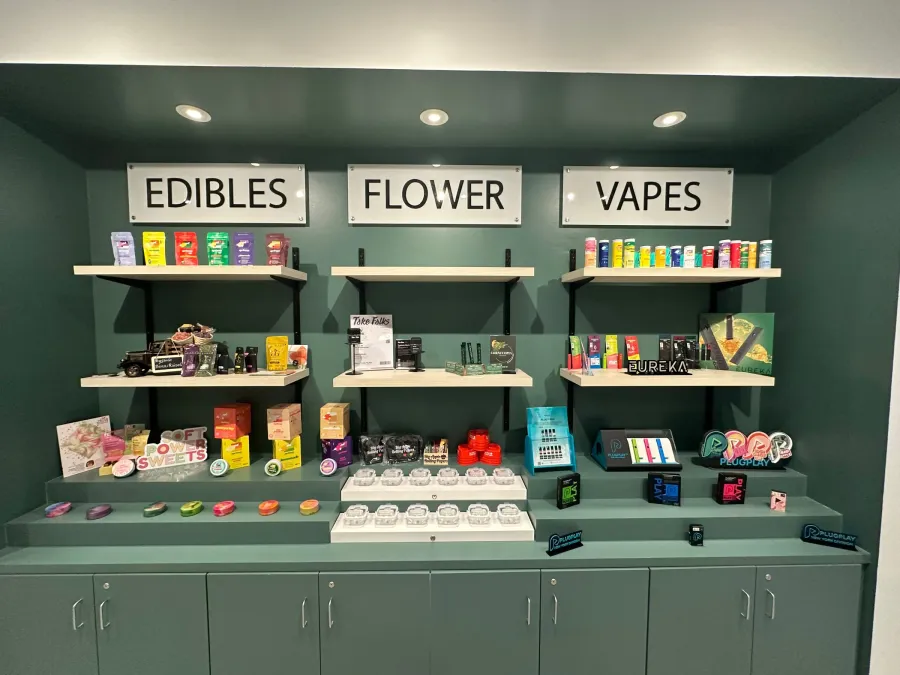
Inside NY Elite Cannabis, 42-15 Bell Blvd, Bayside.
NY Elite Cannabis is a New York State licensed adult-use dispensary (license OCM-CAURD-24-000153) on Bell Blvd in Bayside. Our CBN gummies and drops are licensed, lab-tested New York products, and our budtenders can explain the THC and CBN amounts in each one. Shop in store, or order online for pickup or same-day delivery.
Address: 42-15 Bell Blvd, Bayside, NY 11361 (between 42nd and 43rd Avenues). Directions and parking.
Store hours: 10 AM to 10 PM, every day.
Delivery: same-day delivery across Queens, Nassau County and the Rockaways, with no delivery fees. Ordering hours are Sunday to Friday 11 AM to 8:30 PM and Saturday 6 PM to 8:30 PM. Delivery hours may vary based on driver availability and demand. Minimums and zones are on the delivery page.
Paying: cash or debit in store. Delivery orders are paid online with Dutchie Pay (ACH bank transfer).
Bring ID: you must be 21 or older with a valid government photo ID, in store and at the door.
Marley Grant is part of the family team behind NY Elite Cannabis in Bayside, Queens, and writes about wellness, lifestyle and the neighborhood. More about NY Elite →
Ready to shop?
Browse the live NY Elite menu
Lab-tested, NY-licensed, same-day delivery across Queens, Nassau & the Rockaways. No delivery fees.