What Is CBG? A Guide to Cannabigerol, the Mother Cannabinoid
By Marley Grant, NY Elite Cannabis··11 min read·Updated November 2026
CBG (cannabigerol) is a non-intoxicating cannabinoid found in cannabis and hemp, and its acid form, CBGA, is the starting material the plant uses to make THC and CBD. That is why CBG is often called the "mother cannabinoid." Most plants contain only small amounts of it, but growers now breed hemp that is rich in CBG, and it shows up in tinctures, gummies, drinks and flower.
Below we explain what CBG is, how it is made, what it feels like, how it compares to CBD, THC and CBN, what research has and has not shown, and how to shop for it safely. This guide is from NY Elite Cannabis, a licensed dispensary in Bayside, Queens. It is not medical advice, and we do not make health claims for any product.
CBG is one of more than 100 cannabinoids made by the cannabis plant. It is a "minor" cannabinoid, meaning plants usually make very little of it compared with THC or CBD. Chemically it is the neutral form of cannabigerolic acid (CBGA).
CBGA is where most of the plant's other cannabinoids begin. Enzymes in the plant turn CBGA into THCA, CBDA and CBCA, which become THC, CBD and CBC once heated (Li et al., 2024 review). By the time a plant is mature, most of its CBGA has already been converted, so only a little CBG is left. That is why researchers and the industry call CBG the "mother" or "parent" cannabinoid.
One note on searches: "CBG" is also the abbreviation for cortisol-binding globulin, a protein measured in some blood tests. If your doctor ordered a "CBG test," it has nothing to do with cannabis.
How is CBG made?
The plant builds CBGA from two smaller molecules, olivetolic acid and geranyl pyrophosphate (Nachnani et al., 2021).
Enzymes convert most of it into THCA, CBDA or CBCA as the plant grows.
Heat turns acids into neutral cannabinoids. This step, called decarboxylation, turns CBGA into CBG, the same way THCA becomes THC when you smoke or bake cannabis.
Because ordinary plants leave so little CBG behind, growers breed high-CBG hemp. In these plants the enzymes that would normally convert CBGA into THCA or CBDA do not work, so CBGA builds up instead. Cultivars like "White CBG" were bred this way. CBG can also be produced by fermentation with engineered yeast, which the 2024 review mentions as an emerging source.
Does CBG get you high?
No. CBG is considered non-intoxicating. In the most direct human test so far, a 2024 double-blind study at Washington State University, 34 adults took 20 mg of hemp-derived CBG or a placebo on different days. Their self-rated intoxication averaged under 1 on a 10-point scale with either one, and the researchers measured no impairment (Cuttler et al., 2024).
The exception is products that combine CBG with THC. Many dispensary gummies and vapes are blends such as THC:CBG or THC:CBD:CBG. Those will get you high, because of the THC. Always look at the milligrams of THC on the label.
What does CBG feel like?
People who take CBG on its own often say they notice very little, or describe a subtle, clear-headed feeling. In the 2024 study, participants could not reliably tell CBG from placebo, and the side effects reported were no different from placebo.
That same study measured a few things researchers had not tested in people before. After one 20 mg dose, the CBG group reported lower anxiety ratings than the placebo group over the hour of testing, lower stress ratings at the first check-in only, and no change in mood. The authors point out real limits: it was one small, short study of healthy adults who already used cannabis, it ran remotely, and it was not a treatment trial. They call for larger studies. In other words, it is an early result, not proof that CBG does anything for anxiety.
What does CBG do in the body?
Scientists know more about how CBG behaves in lab tests than in people. Reviews describe it as acting on several targets (Li et al., 2024; Nachnani et al., 2021):
Cannabinoid receptors: it binds weakly to CB1 (the receptor THC activates to cause a high) and acts on CB2. Its activity at these receptors falls somewhere between THC and CBD.
Other receptors: it is a strong activator of the alpha-2 adrenergic receptor in lab tests, and it also acts on some TRP channels and PPAR receptors.
Metabolism: liver enzymes in the cytochrome P450 family break CBG down quickly, the same enzyme family that handles many prescription drugs.
What those lab findings mean for people is not known yet.
What is CBG being studied for?
You will see long lists of CBG "benefits" online. Here is the honest picture. Researchers have looked at CBG in cell and animal studies on topics including inflammation, nerve cell health in models of Huntington's and Parkinson's disease, bowel inflammation, bacteria, eye pressure, appetite, and metabolism (Li et al., 2024). Animal and cell results often do not hold up in people.
Human research is very thin. The 2024 Washington State study noted that only two clinical trials of CBG had been published before it. The FDA has not approved CBG for any use, and it says marketing an unapproved cannabis product with claims that it treats or prevents disease is against the law (FDA). So we do not claim CBG treats, relieves or prevents anything. If you are interested in CBG for a health reason, talk to your doctor.
CBG vs CBD: what is the difference?
CBG and CBD are both non-intoxicating and both commonly come from hemp, which is why they are often compared. The main differences:
CBG vs CBD vs THC vs CBN
CBG
CBD
THC
CBN
Gets you high
No
No
Yes
Mildly, much weaker than THC
How it forms
From CBGA, the precursor acid
CBGA → CBDA → CBD
CBGA → THCA → THC
THC breaks down with age, heat and light
Amount in most plants
Small
High in hemp
High in marijuana-type cannabis
Small; more in aged cannabis
Human research
Very limited
More studied; one FDA-approved drug (Epidiolex)
Most studied; synthetic THC drugs approved
Very limited
Common products
Tinctures, gummies, drinks, blends
Tinctures, gummies, topicals, drinks
Flower, vapes, edibles, concentrates
Blended gummies and drops
Is CBG "more powerful" than CBD? There is no good evidence either way. They act on some of the same receptors in different ways, and CBG has been studied far less. CBG products also tend to cost more, because there is so little of it in most plants. For more on the big two, read our CBD vs THC guide.
CBG vs THC and CBN
THC is the cannabinoid that produces a high, and CBG does not. Interestingly, CBG and THC come from the same parent molecule: THC exists only because the plant converted CBGA into THCA. CBN is different again. It forms when THC slowly breaks down from age, heat and light, and it is mildly intoxicating. See our full guide to what CBN is.
Is CBG legal?
Federally: the 2018 Farm Bill made hemp (cannabis with no more than 0.3% delta-9 THC) legal to grow and removed it from the Controlled Substances Act, and most CBG comes from hemp (FDA). The FDA still regulates hemp products, and it has not approved CBG as a drug, food ingredient or supplement. A federal law passed in 2025 changes the definition of hemp, counting total THC and capping THC per container in finished products, with the new rules taking effect in late 2026. It does not ban CBG by name, but it will push some hemp products with THC off the shelves of unlicensed stores.
In New York: hemp products sold for their cannabinoid content are regulated through the Office of Cannabis Management's cannabinoid hemp program, which sets testing and labeling rules. CBG products that contain THC, like THC:CBG gummies, are adult-use cannabis products: they are for adults 21 and older and must be bought from a licensed dispensary. New York adults can possess up to 3 ounces of cannabis and 24 grams of concentrated cannabis (OCM fact sheet).
Will CBG show up on a drug test?
Standard drug tests look for a THC metabolite, not CBG, and pure CBG is not expected to trigger one. The risk is THC in the product. CBG extracts can carry over small amounts of THC, and label accuracy for cannabinoid products is a known problem: the NIH says some products contain amounts that "differ substantially" from their labels. If you are tested for work, avoid full-spectrum products and products blended with THC, and check the lab certificate for a THC result.
Is CBG safe? Side effects and safe use
Too few people have been studied to know CBG's full safety profile, and the 2024 review says more clinical safety work is needed. In the small 2024 trial, side effects were no different from placebo. Some practical guidance:
Medications: CBG is broken down by the same liver enzymes as many prescription drugs, so check with a pharmacist or doctor before using it if you take medication.
Liver: in one mouse study described in the 2024 review, a high dose of CBG made liver injury worse while a low dose did not. What that means for people is unknown, which is another reason to stick to the label serving.
Pregnancy and breastfeeding: there is no CBG safety data, so avoid it.
Blends with THC: treat them like any THC product. Do not drive, start low and wait, and keep them away from children and pets.
Buy tested products: licensed New York products have a QR code that links to lab results. Unlicensed products may not.
Age: adult-use cannabis products, including THC:CBG blends, are for adults 21 and older.
How do people take CBG?
Tinctures and oils: drops held under the tongue or added to a drink. Easy to measure in small amounts.
Gummies and other edibles: often CBG paired with CBD or THC. Slower to take effect; read the THC amount if there is any.
Drinks: seltzers and sodas with a set amount of CBG per can.
Vapes: usually blends, such as THC with CBG or THCV.
CBG flower: high-CBG hemp flower smoked or vaped. Smokable hemp is 21+ in New York.
There is no established "dose" for CBG. The 2024 study used a single 20 mg dose; products on the market range from a few milligrams per serving to much more. Follow the serving size on the package.
How to read a CBG label
Find the milligrams per serving of CBG, and of THC and CBD if listed.
Check the ratio. "THC:CBG 2:1" means twice as much THC as CBG.
Look at the type: full-spectrum (other plant compounds, possibly trace THC), broad-spectrum (THC removed) or isolate (CBG only).
Scan the QR code for the certificate of analysis and compare the lab numbers with the label.
CBG products at NY Elite
Here are CBG products on our menu right now. Tap one to see it on the live menu; stock and prices change daily.
Browse all tinctures and edibles, or ask a budtender which CBG products are in stock today.
Frequently asked questions
What is CBG?
CBG, or cannabigerol, is a non-intoxicating cannabinoid found in cannabis and hemp. Its acid form, CBGA, is the precursor the plant converts into THC, CBD and CBC, which is why CBG is called the mother cannabinoid.
Does CBG get you high?
No. CBG is non-intoxicating. In a 2024 double-blind study, people rated their intoxication under 1 out of 10 after 20 mg of CBG, the same as placebo. Products that blend CBG with THC will get you high because of the THC.
Is CBG better than CBD?
There is no good evidence that one is better. Both are non-intoxicating, but CBD has been studied far more, and CBD is the basis of one FDA-approved drug. CBG has very little human research so far.
Can you fail a drug test from CBG?
Drug tests look for a THC metabolite, not CBG. But some CBG products contain THC, either by design or from extraction, so a CBG product can cause a positive THC test. Check the lab results for THC.
What does CBG feel like?
Most people notice little or nothing intoxicating. In a 2024 study, participants could not reliably tell CBG from placebo, and side effects matched placebo.
Is CBG legal in New York?
Hemp-derived CBG products are regulated under New York's cannabinoid hemp program. CBG products that contain THC are adult-use cannabis products, sold only at licensed dispensaries to adults 21 and older.
Why is CBG called the mother cannabinoid?
Because the plant makes cannabigerolic acid (CBGA) first and then converts it into THCA, CBDA and CBCA. Those acids become THC, CBD and CBC when heated.
Is CBG hard on your liver?
There is not enough human data to say. CBG is processed by liver enzymes, and one animal study found a high dose worsened liver injury while a low dose did not. Ask a doctor if you have liver disease or take medication.
Where to buy CBG in Bayside, Queens
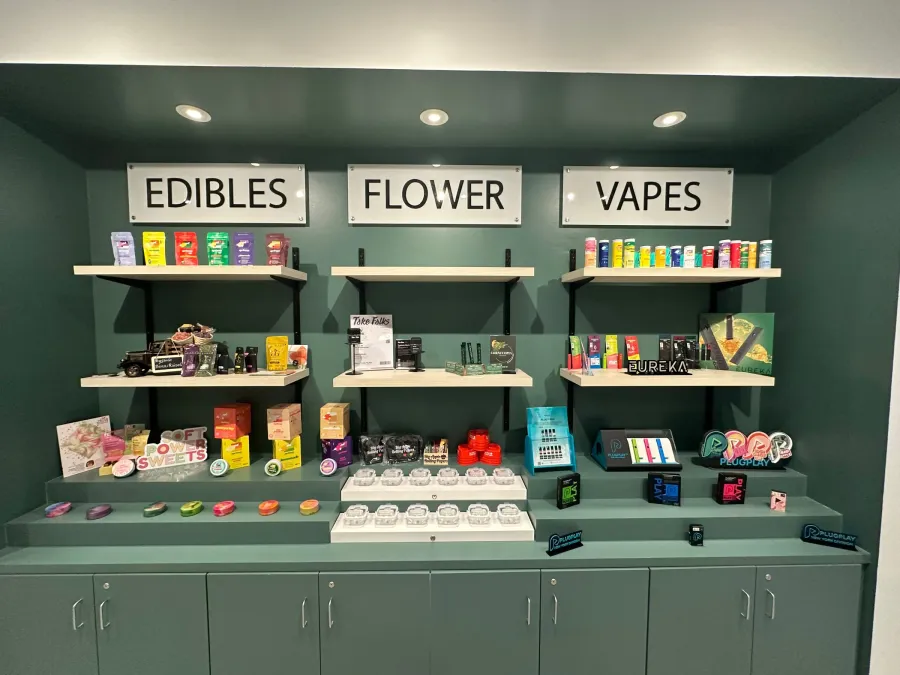
Inside NY Elite Cannabis, 42-15 Bell Blvd, Bayside.
NY Elite Cannabis is a New York State licensed adult-use dispensary (license OCM-CAURD-24-000153) on Bell Blvd in Bayside. We carry CBG tinctures, drinks and gummies, plus THC blends with CBG, and every licensed product comes with lab results you can scan. Stop in to compare them, or order online for pickup or same-day delivery.
Address: 42-15 Bell Blvd, Bayside, NY 11361 (between 42nd and 43rd Avenues). Directions and parking.
Store hours: 10 AM to 10 PM, every day.
Delivery: same-day delivery across Queens, Nassau County and the Rockaways, with no delivery fees. Ordering hours are Sunday to Friday 11 AM to 8:30 PM and Saturday 6 PM to 8:30 PM. Delivery hours may vary based on driver availability and demand. Minimums and zones are on the delivery page.
Paying: cash or debit in store. Delivery orders are paid online with Dutchie Pay (ACH bank transfer).
Bring ID: you must be 21 or older with a valid government photo ID, in store and at the door.
Marley Grant is part of the family team behind NY Elite Cannabis in Bayside, Queens, and writes about wellness, lifestyle and the neighborhood. More about NY Elite →
Ready to shop?
Browse the live NY Elite menu
Lab-tested, NY-licensed, same-day delivery across Queens, Nassau & the Rockaways. No delivery fees.